PhD Student in Design at the Politecnico di Milano, he’s affiliated to DensityDesign Lab where he started as Junior Research Assistant in 2019. He works at the intersection of data visualization, creative coding and communication design. He worked on interfaces for the curatorial and serendipitous exploration for digital archives of cultural heritage and is now focusing on the role of interfaces and the role of design in general in shaping awareness on how data is produced online by users. His teaching efforts are focused on teaching data visualization to students of various backgrounds, as well as creative coding as an expressive practice for designers. From 2017, he collaborates with the Digital Methods Initiative at the University of Amsterdam.

PhD Research Topic

Designing the presence of data in society. A frictional approach

At the intersection of ubiquitous technology in society, the amassing of personal data, and the responsibility of the design practice, a misalignment between big tech companies and the population becomes apparent. In this opaque system where value is created from data produced online (Hankey & Tuszynski, 2017), a rising concern among the population regards what kind of data is collected and for what purposes. “Is my phone listening to me?” is a peculiar question that probably we heard or asked ourselves (Kröger & Raschke, 2019), and synthesize these levels of opacity: an uncertainty about the hardware, the software, and the backed services. These doubts and behaviors reveal an underlying need to retake control of the digital traces we leave behind on digital platforms.

This misalignment – and how to act on it – is worth exploring: while design and technology are usually valued when efficient and smooth in enabling actions (Hallnäs & Redström, 2001) also when designing , efforts have been made instead in repositioning design as a critical practice to make commentary. The central research hypothesis is that “slowing down” design products that employ technology in their fruition could be a relevant, if little, part of the solution. In juxtaposition to efficiency in design, the term “friction” is hypothesized from the surfacing of this term in the design community.

Research
Publications

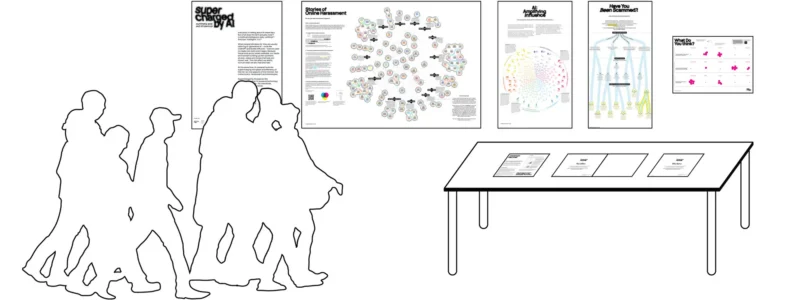
Supercharged by AI: Information Design Approaches for a MIL Public Engagement Initiative

Elena Aversa, Michele Mauri, Angeles Briones, Andrea Benedetti. 2026. DIID. Disegno Industriale Industrial Design, 87, 98–113.

Algorithmic you. Un design-setting per la riappropriazione dei dati personali attraverso narrazioni poetiche e rivisitando mo-delli di poesia visiva

Andrea Benedetti, Angeles Briones, Arianna Bellantuono. 2024. Ocula, 30, 262–286.

Curating data for urban biodiversity: three catalogues on local issues in Milan

Gabriele Colombo, Andrea Benedetti. 2024. In Embracing change and supporting transitions. Approaches to systemic change in products, services and systems (pp. 81–96). FrancoAngeli.

Data Design as a Frictional Layer: Data Collections and Design Actions to Produce Discursive Communication Artifacts

Andrea Benedetti, Michele Mauri. 2024. In The Sage Handbook of Data and Society (pp. 483–499). London: SAGE Publications Ltd.

Design for friction. An inquiry to position friction as a method for reflection in design interventions

Andrea Benedetti, Michele Mauri. 2023. Convergências, 16(31), 139–146.

Designing network visualizations for genetic literary criticism

Tommaso Elli, Andrea Benedetti, Valentina Pallacci, Elena Spadini, Michele Mauri. 2023. Convergências, 16(31), 25–38.

Genetic networks: data model and visualisations

E. Spadini, A. Christen, Valentina Pallacci, Tommaso Elli, Andrea Benedetti, D. Maggetti, Michele Mauri, S. Péterman. 2023. Digital Humanities 2023: Book of Abstracts, 319–321. Graz: Zentrum für Informationsmodellierung - Austrian Centre for Digital Humanities, University of Graz.

Making posters to understand statistics: towards a didactical approach in communication design

Michele Mauri, Simone Vantini, Beatrice Gobbo, Tommaso Elli, Elena Aversa, Andrea Benedetti, Angeles Briones, Gabriele Colombo. 2022. DRS2022: Bilbao, 1–18.

QUARANTILES. Archiving expressive digital places from Instagram during the COVID-19 pandemic

Andrea Benedetti, Giacomo Flaim, Beatrice Gobbo. 2022. 2022 IEEE VIS Arts Program (VISAP), 39–52.

Staging and storing data sprint-based research results: a communication design approach

Beatrice Gobbo, Angeles Briones, Elena Aversa, Tommaso Elli, Andrea Benedetti, Michele Mauri, Gabriele Colombo. 2022. Dígitos, 1(8), 87–108.

Visualizing the genetic process of literary works

Valentina Pallacci, Andrea Benedetti, Tommaso Elli, Michele Mauri. 2022. In F. Ciracì, G. Miglietta, & C. Gatto (Eds.), Culture digitali. Intersezioni: Filosofia, arti, media. (pp. 179–184)

Erbario Vaccinale

Andrea Benedetti, G. Flaim, Beatrice Gobbo. 2021. Il mestiere di grafico – oggi. Milano, Triennale Design Museum: AIAP.

Expressive digital place making as means of aggregation: a case study from the COVID-19 pandemic

Beatrice Gobbo, Andrea Benedetti. 2021. CHItaly 2021: 14th Biannual Conference of the Italian SIGCHI Chapter. Association for Computing Machinery, 1–5. New York: Association for Computing Machinery.

Mapping online visuals of shale gas controversy: a digital methods approach

Elaine Teixeira Rabello, Efrat Gommeh, Andrea Benedetti, Gabriel Valerio-Ureña, Tamara Metze. 2021. Information, Communication & Society, (15), 1–18.

“Drawing with Code”: the Experience of Teaching Creative Coding as a Skill for Communication Designers

Andrea Benedetti, Tommaso Elli, Michele Mauri. 2020. 12th International Conference on Education and New Learning Technologies, 3478–3488